Men's health
Testosterone monitoring blood test in Liverpool
TRT should be monitored properly.
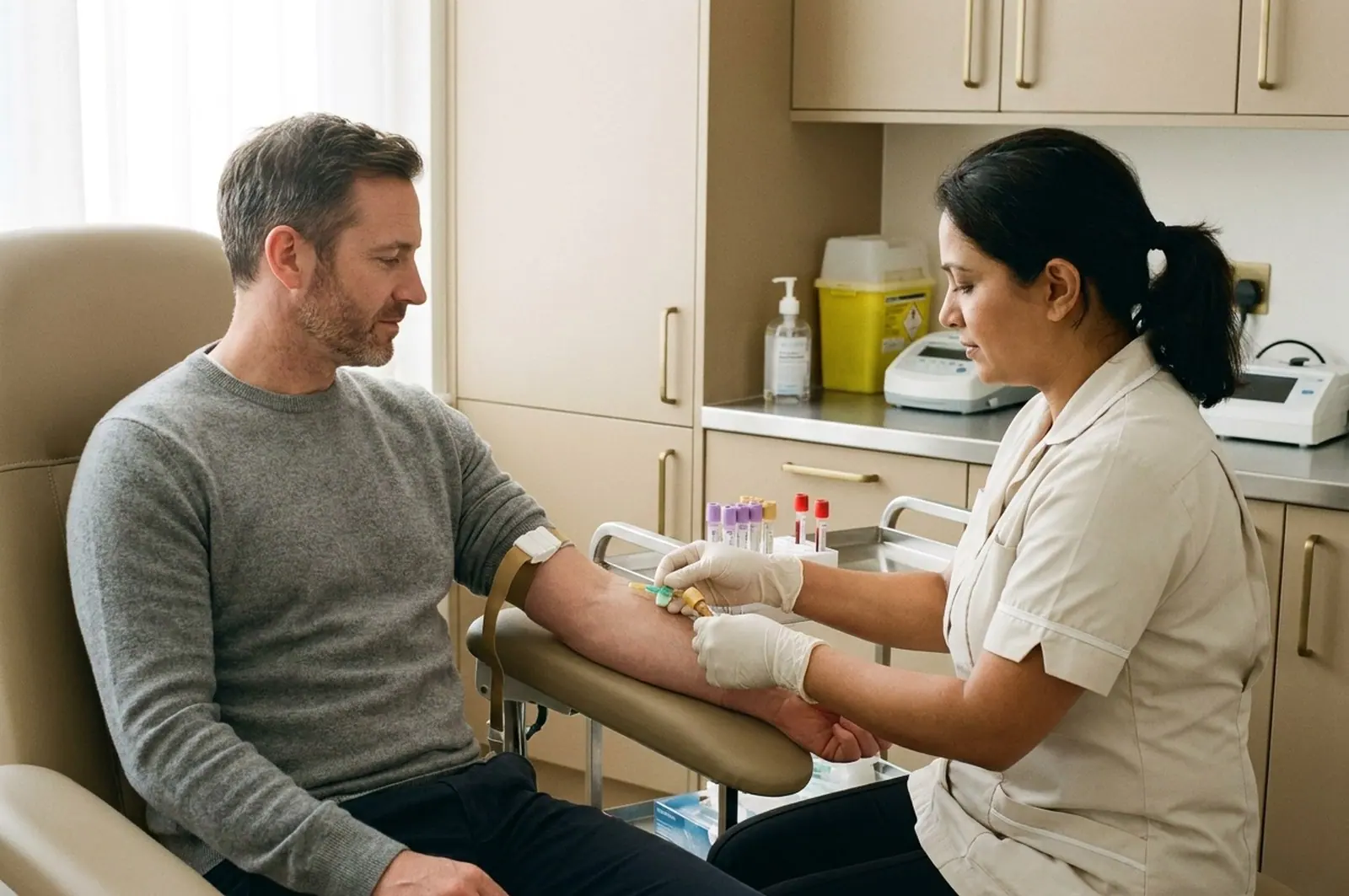
The Male TRT Monitoring & Surveillance Test is a testosterone monitoring blood test for men in Liverpool who are already under a prescriber's care and want their monitoring bloods taken in clinic. One venous sample, taken by a clinician at 57 Rodney Street, is tested for 27 markers, including testosterone, free testosterone, SHBG, oestradiol, a prostate profile (PSA), a full blood count, cholesterol, HbA1c, liver and kidney markers.
57 Health does not prescribe, supply or advise on treatment. This page and this test are about the blood sample only. We take it, a clinician checks the results and we send them to you securely. Your prescriber or GP decides what they mean for your care, so please do not change anything about your treatment based on this page or on our report.
Monitoring is usually set by whoever prescribes. NHS trust patient information for people using testosterone replacement therapy (TRT) describes annual blood tests that include a full blood count, liver function tests, testosterone and PSA. Check your prescriber's request against the marker list below before you book.
What's tested
27 biomarkers from a single venous sample.
| Marker | What it tells you |
|---|---|
| Total Cholesterol/HDL Cholesterol Ratio | Total cholesterol divided by HDL. A lower ratio generally points to a more favourable balance. |
| Full Blood Count | Counts your red cells, white cells and platelets and measures haemoglobin. It gives a broad picture of anaemia, infection and clotting cells. |
| Ferritin | Your body's iron store, and usually the first marker to fall when iron runs low. |
| Total Cholesterol | All the cholesterol carried in your blood, and a starting point for heart-health risk. |
| LDL Cholesterol | The cholesterol that can build up in artery walls over time. Lower is generally more favourable. |
| HDL Cholesterol | Cholesterol being carried away from your arteries. Higher is generally more favourable. |
| Triglycerides | A blood fat linked to diet, alcohol, weight and blood sugar control. |
| HbA1c | Your average blood sugar over roughly the last two to three months. |
| Creatinine | A waste product from muscle that your kidneys filter out. It is used to judge kidney function. |
| Chloride | An electrolyte that works with sodium to balance fluids in the body. |
| Potassium | An electrolyte that matters for nerves, muscles and the heart. |
| Sodium | The main electrolyte that controls your body's fluid balance. |
| Urea | A waste product from protein breakdown that your kidneys clear. |
| Alanine Aminotransferase (ALT) | A liver enzyme that rises when liver cells are irritated or damaged. |
| Alkaline Phosphatase (ALP) | An enzyme found in the liver and bones, used to check both. |
| Aspartate Aminotransferase (AST) | An enzyme found in the liver and muscle, read alongside ALT. |
| Gamma-Glutamyltransferase (GGT) | A liver and bile-duct enzyme that is sensitive to alcohol and some medicines. |
| Total Bilirubin | A yellow pigment made when red cells break down, which the liver processes. |
| Albumin | The main protein made by your liver. It reflects nutrition and liver and kidney health. |
| Oestradiol | The main form of oestrogen. It follows your cycle and changes through the menopause. |
| Follicle Stimulating Hormone (FSH) | A pituitary hormone that drives egg development. It rises as the ovaries slow down, including around the menopause. |
| Luteinising Hormone (LH) | A pituitary hormone that triggers ovulation, read alongside FSH and oestradiol. |
| Prolactin | A pituitary hormone that supports milk production. A raised level can affect periods, fertility and libido. |
| Testosterone | The main male sex hormone, also present in smaller amounts in women. It influences energy, mood, libido and muscle. |
| Sex Hormone Binding Globulin (SHBG) | A protein that binds sex hormones, which affects how much testosterone and oestrogen is available. |
| Free Testosterone | The part of your testosterone that is not bound to proteins and is available to your tissues. |
| Prostate Profile | A check of prostate-related blood markers, including PSA (prostate-specific antigen). A raised PSA has several possible causes and is one piece of information, not a diagnosis. |
Understand what's measured
Plain-English guides to the markers in this panel: what each one checks, and what high and low results can mean.
- Cholesterol blood test
- Ferritin blood test
- HbA1c blood test
- Creatinine & eGFR blood test
- Potassium blood test
- Urea blood test
- ALP blood test
- GGT blood test
Read more
Who this blood test may suit
You are under a prescriber's care and need monitoring bloods
Your prescriber sets what is checked and when. This panel covers the markers most often asked for in routine monitoring, and gives you a clinician-checked report that you can share with them.
You want the sample taken at a specific time
When a testosterone sample is taken affects how the result is read. Lab Tests Online UK notes that levels are highest in the morning, and NHS patient information refers to samples timed in relation to a person's own schedule. Tell us what your prescriber has asked for when you book.
You want your results in your own hands
Results come back typically within 1–3 working days and are sent to you securely, so you can pass them to your prescriber or GP in whatever way suits them.
You want the wider health markers checked at the same time
Alongside the hormones, the panel includes cholesterol, HbA1c, ferritin, liver and kidney markers and a full blood count, so one appointment covers the general health bloods that often sit in a monitoring request.
What happens at your appointment
- 1
Arrive at 57 Rodney Street for your appointment. No GP referral needed.
- 2
Your clinician confirms the right test for you and answers any questions.
- 3
A quick venous blood draw, taken by a clinician.
- 4
Your results are sent to you securely, with clear guidance on any recommended next steps.
How to prepare for your test
- You do not need a GP referral. You can book this test directly online.
- Whether you need to fast depends on the panel. We confirm exactly what to do when your booking is confirmed, and you can call the clinic if you are unsure.
- Tell us what your prescriber has asked for, and when your most recent treatment was. Follow their instructions about when to book in relation to your own schedule, and let us know when you book so we can note it.
- Book a morning appointment if you can. Testosterone is highest in the morning, so a morning sample is easier to compare with other results.
- For the two days before the test, the NHS advises against ejaculating, cycling and exercise that leaves you out of breath, as these can raise PSA. If you have had a urine infection, wait 4 to 6 weeks after it has cleared.
What your results can and cannot tell you
What they can show
- Your testosterone, free testosterone and SHBG results as measured on the day. Lab Tests Online UK explains that most testosterone travels bound to proteins such as SHBG, and only a small share is free.
- Your oestradiol, LH, FSH and prolactin, which give wider hormone context to the testosterone result.
- A prostate profile, including PSA, so you and your prescriber have a recent value to compare against earlier ones.
- Your full blood count, which looks at your red cells and can report haematocrit, the proportion of your blood made up of red blood cells.
- Your cholesterol profile, HbA1c, ferritin, and liver and kidney markers, as general health context.
What they cannot show
- Anything about your treatment. We do not prescribe, supply or advise on treatment, and a report from us is not a recommendation to change anything.
- A diagnosis. A result outside the range is a reason for a conversation with your prescriber or GP, and a PSA result cannot rule prostate cancer in or out on its own.
- Anything outside the 27 markers listed. Thyroid markers, eGFR, calcium and deeper cardiovascular risk markers are not included.
- Whether your result suits you. Whether a number is right for you depends on your symptoms, history and plan, which your prescriber knows and we do not.
When you get your results, and what happens next
Most results are back within 1–3 working days depending on the panel. They are checked by a clinician and sent to you securely, with clear guidance on what to do next, including onward referral where appropriate. If you would like to talk them through, you can add a 30-minute clinician review for £30.
Your report is checked by a clinician and sent to you securely. Share it with your prescriber or GP, who will decide what the results mean for your care. If a result falls outside the reference range, our clinician will say so plainly and suggest you speak to them, and we will not suggest changes to treatment.
A raised PSA is usually repeated before anything else is decided. If it stays high, the NHS says a GP may discuss referral to a specialist for further tests. A 30-minute clinician review (£30) can go through what each marker measures. It does not cover your treatment.
Price and booking
The Male TRT Monitoring & Surveillance Test is £140, paid securely online when you book. Appointments are at 57 Rodney Street, Liverpool, Monday to Friday. You can book online, see all test prices, or read how a visit works.
Frequently asked questions
This page is for general information. Blood tests are carried out following a short clinical check to confirm the panel is appropriate for you. Your results are sent to you securely, with clear guidance on any recommended next steps.