Everyday health
General health blood test in Liverpool
A sensible starting point for a clear overview of your health.
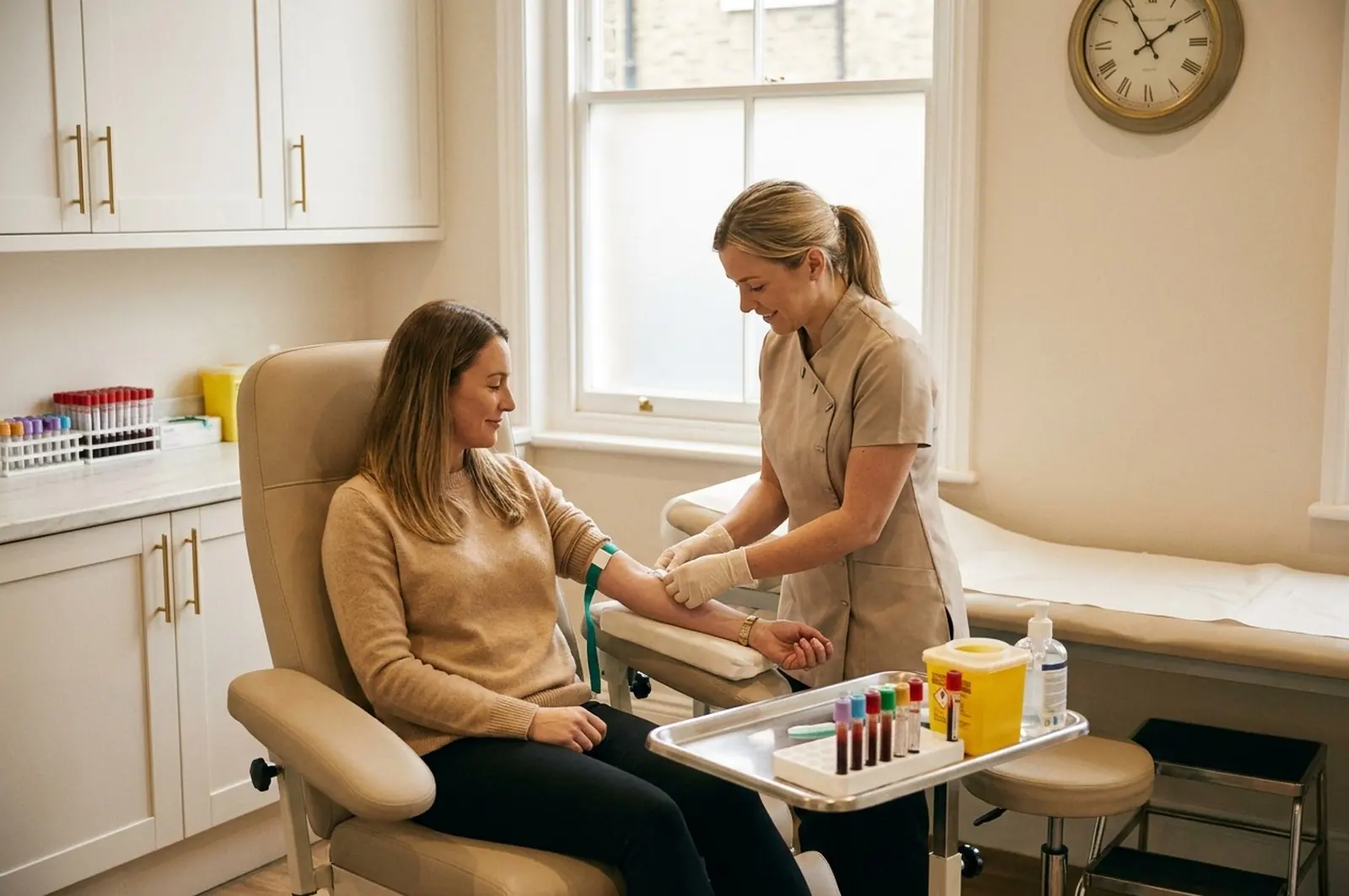
The General Health Screen is a general health blood test for people who want a broad, clear picture of how they are doing. One venous sample, taken by a clinician at 57 Rodney Street in Liverpool, is tested for 29 markers across blood health, iron stores, cholesterol, blood sugar control, kidney function and liver function.
It is a sensible starting point if you have not had your bloods checked for a while, or you simply want a baseline to compare against later. It does not look at hormones or performance markers. If those are what you are after, the other panels cover them.
What's tested
29 biomarkers from a single venous sample.
| Marker | What it tells you |
|---|---|
| Total Cholesterol/HDL Cholesterol Ratio | Total cholesterol divided by HDL. A lower ratio generally points to a more favourable balance. |
| Full Blood Count | Counts your red cells, white cells and platelets and measures haemoglobin. It gives a broad picture of anaemia, infection and clotting cells. |
| Iron | The iron circulating in your blood right now. It shifts through the day and after meals, so it is read alongside ferritin. |
| Ferritin | Your body's iron store, and usually the first marker to fall when iron runs low. |
| Total Iron Binding Capacity (TIBC) | How much iron your blood is able to carry. It tends to rise when iron stores are low. |
| Transferrin | The protein that carries iron around your body. |
| Transferrin Saturation | The share of that carrier protein currently loaded with iron. |
| Total Cholesterol | All the cholesterol carried in your blood, and a starting point for heart-health risk. |
| LDL Cholesterol | The cholesterol that can build up in artery walls over time. Lower is generally more favourable. |
| HDL Cholesterol | Cholesterol being carried away from your arteries. Higher is generally more favourable. |
| Triglycerides | A blood fat linked to diet, alcohol, weight and blood sugar control. |
| Creatine Kinase | A muscle enzyme that rises after hard exercise or muscle strain. |
| HbA1c | Your average blood sugar over roughly the last two to three months. |
| Creatinine | A waste product from muscle that your kidneys filter out. It is used to judge kidney function. |
| Calcium (Adjusted) | Calcium in your blood, corrected for albumin. It matters for bones, nerves and muscles. |
| Chloride | An electrolyte that works with sodium to balance fluids in the body. |
| Potassium | An electrolyte that matters for nerves, muscles and the heart. |
| Sodium | The main electrolyte that controls your body's fluid balance. |
| Urea | A waste product from protein breakdown that your kidneys clear. |
| Uric Acid | A waste product that can build up and form crystals in the joints, as in gout. |
| Estimated Glomerular Filtration Rate (eGFR) | An estimate of how well your kidneys filter blood, calculated from creatinine, age and sex. |
| Total Protein | The total of the main proteins in your blood, albumin and the globulins. |
| Alanine Aminotransferase (ALT) | A liver enzyme that rises when liver cells are irritated or damaged. |
| Alkaline Phosphatase (ALP) | An enzyme found in the liver and bones, used to check both. |
| Aspartate Aminotransferase (AST) | An enzyme found in the liver and muscle, read alongside ALT. |
| Gamma-Glutamyltransferase (GGT) | A liver and bile-duct enzyme that is sensitive to alcohol and some medicines. |
| Total Bilirubin | A yellow pigment made when red cells break down, which the liver processes. |
| Albumin | The main protein made by your liver. It reflects nutrition and liver and kidney health. |
| Globulin | A group of proteins that includes antibodies, giving context on immune and liver activity. |
Understand what's measured
Plain-English guides to the markers in this panel: what each one checks, and what high and low results can mean.
- Cholesterol blood test
- Iron blood test
- Ferritin blood test
- TIBC blood test
- Transferrin saturation blood test
- Creatine kinase blood test
- HbA1c blood test
- Creatinine & eGFR blood test
Read more
How this test compares with Thriva, Randox Health and Numan
Who this blood test may suit
You have not had a blood test for a while
A broad panel gives you a baseline across the main body systems in one visit, so any later change has something to be measured against.
You want to check cholesterol and diabetes risk
The panel includes a full cholesterol profile and HbA1c, which reflects your average blood sugar over the last two to three months.
You are tired or run down and want somewhere to start
Anaemia and low iron stores are common, checkable reasons for feeling tired. This panel looks at both. If tiredness is your main concern, the Enhanced Fatigue Screen adds thyroid, vitamin D, B12 and folate.
You are 40 or over and not under regular review
The NHS Health Check offers a similar cardiovascular check every five years to people aged 40 to 74 without an existing condition. If you have not been invited, or want to check sooner, this is a private way to look at the same areas, and more.
What happens at your appointment
- 1
Arrive at 57 Rodney Street for your appointment. No GP referral needed.
- 2
Your clinician confirms the right test for you and answers any questions.
- 3
A quick venous blood draw, taken by a clinician.
- 4
Your results are sent to you securely, with clear guidance on any recommended next steps.
How to prepare for your test
- You do not need a GP referral. You can book this test directly online.
- Whether you need to fast depends on the panel. We confirm exactly what to do when your booking is confirmed, and you can call the clinic if you are unsure.
- Mention any medicines or supplements when you book or arrive. Some can affect results, and your clinician will want to know.
- Drink water as normal beforehand. Being well hydrated makes the blood draw easier.
What your results can and cannot tell you
What they can show
- Whether your blood count, haemoglobin and iron stores sit within the laboratory's reference range.
- Your cholesterol balance, including LDL, HDL, triglycerides and the total-to-HDL ratio.
- Your average blood sugar over recent months, through HbA1c, which can flag higher diabetes risk.
- How your kidneys and liver are working, through creatinine, eGFR and the liver enzymes.
- A baseline you can repeat in six or twelve months to see which way things are heading.
What they cannot show
- A diagnosis. A result outside the range is a prompt for a conversation, not a conclusion, and your GP is the right person for any diagnosis.
- Anything outside the markers listed, such as hormones, thyroid function or vitamin levels, which have their own panels.
- Blood pressure, weight, heart rhythm or any other measurement that is not a blood marker.
- How you feel on the day. Results are one piece of information alongside your symptoms and history.
When you get your results, and what happens next
Most results are back within 1–3 working days depending on the panel. They are checked by a clinician and sent to you securely, with clear guidance on what to do next, including onward referral where appropriate. If you would like to talk them through, you can add a 30-minute clinician review for £30.
If a result falls outside the reference range, your clinician will say so plainly and explain what it may mean, then suggest a sensible next step. That could be repeating the test, lifestyle changes, or a conversation with your GP, who can arrange further investigation if needed.
Many people book the same panel again after six to twelve months. Because the sample, the laboratory and the markers are the same, the comparison is like for like.
Price and booking
The General Health Screen is £95, paid securely online when you book. Appointments are at 57 Rodney Street, Liverpool, Monday to Friday. You can book online, see all test prices, or read how a visit works.
Frequently asked questions
This page is for general information. Blood tests are carried out following a short clinical check to confirm the panel is appropriate for you. Your results are sent to you securely, with clear guidance on any recommended next steps.