Everyday health
Thyroid blood test in Liverpool
The complete thyroid picture, not just TSH.
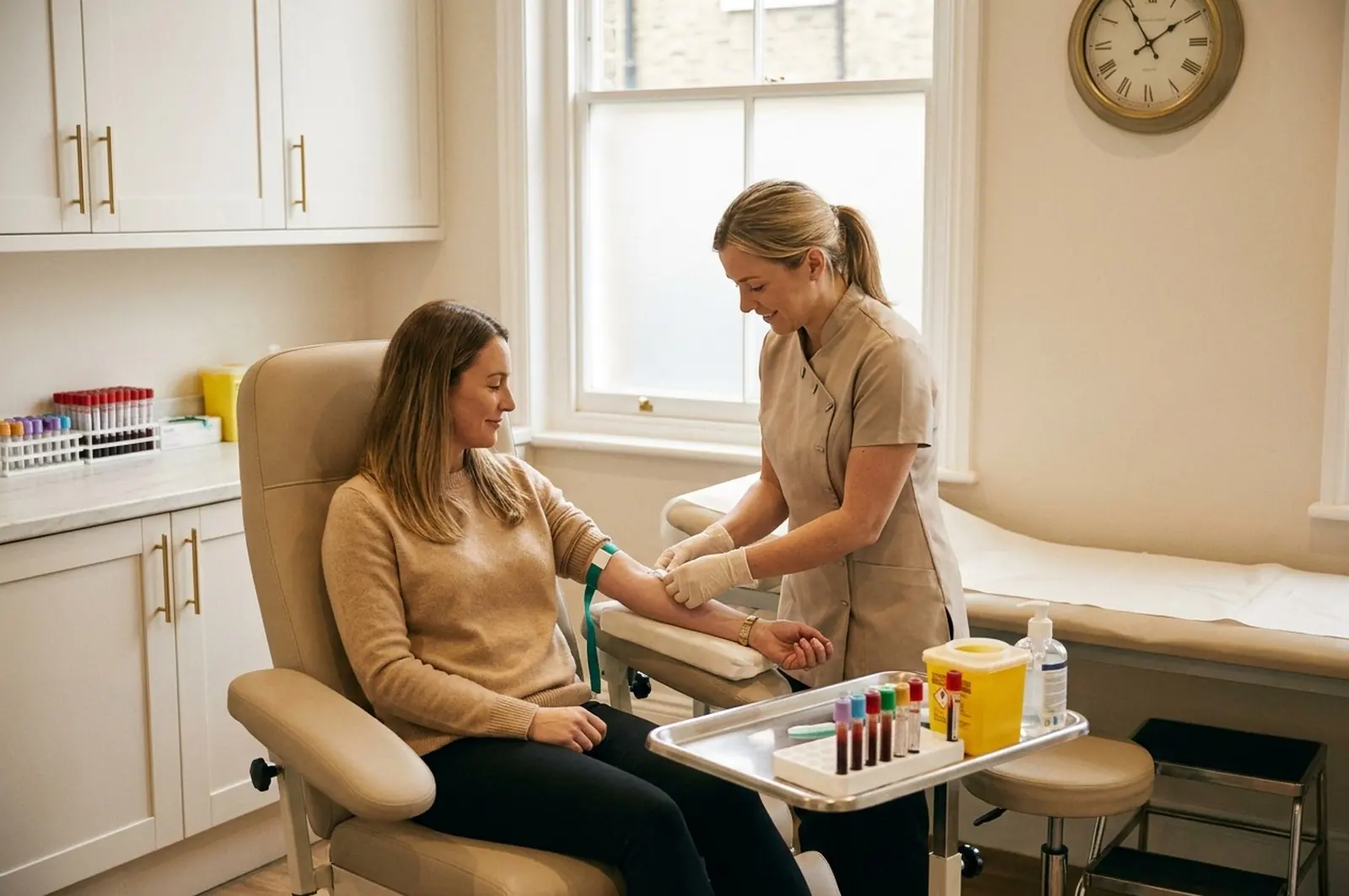
The Ultimate Specialist Thyroid Screen is a thyroid blood test in Liverpool that goes further than a standard thyroid function test. One venous sample, taken by a clinician at 57 Rodney Street, is tested for five markers: TSH, free T4 and free T3, which show how your thyroid is working, and anti-TPO and anti-thyroglobulin antibodies, which can point to an autoimmune cause.
You do not need a GP referral. The screen suits people who want thyroid function and thyroid antibodies looked at together, for example after a single TSH result that did not explain things, or because thyroid conditions run in the family. It shows where your results sit against the laboratory's reference range. It does not give a diagnosis: that is a decision for your GP, who also decides on any care that follows.
What's tested
5 biomarkers from a single venous sample.
| Marker | What it tells you |
|---|---|
| Thyroid Stimulating Hormone (TSH) | The signal from your pituitary gland that tells your thyroid how hard to work. It is the usual first thyroid check. |
| Free Thyroxine (FT4) | Free thyroxine, the main thyroid hormone available to your body's tissues. |
| Free Tri-iodothyronine (FT3) | Free T3, the more active thyroid hormone, made from T4. |
| Anti-Thyroglobulin Antibody (Anti-Tg) | Antibodies against thyroglobulin, a thyroid protein. They can point to an autoimmune thyroid condition. |
| Anti-Thyroid Peroxidase Antibody (Anti-TPO) | Antibodies against an enzyme in the thyroid. They are commonly raised in autoimmune thyroid conditions. |
Understand what's measured
Plain-English guides to the markers in this panel: what each one checks, and what high and low results can mean.
See all blood test guidesRead more
How this test compares with Thriva, Randox Health and Numan
Who this blood test may suit
You have symptoms that could fit an underactive or overactive thyroid
The NHS lists tiredness, feeling cold, weight gain, dry skin and hair loss among the common symptoms of an underactive thyroid, and nervousness, difficulty sleeping, sensitivity to heat, palpitations and weight loss among those of an overactive one. Many of these have other causes, so a result gives context rather than an answer.
You had a borderline or one-off TSH result
The British Thyroid Foundation describes a slightly raised TSH with a free T4 in range as subclinical hypothyroidism, and says an antibody test helps judge the risk of it progressing. This screen puts TSH, free T4 and antibodies side by side.
Thyroid or autoimmune conditions run in your family
The NHS says you are more likely to have an underactive thyroid if others in your family have had a thyroid condition. A family history of autoimmune conditions is also one of the reasons the British Thyroid Foundation gives for having thyroid function checked.
You have irregular periods or fertility questions
The British Thyroid Foundation lists fertility problems and abnormal menstrual cycles among the reasons to check thyroid function. If you are pregnant, or planning a pregnancy and already have a thyroid condition, tell your GP: reference ranges differ in pregnancy.
You want a second look at thyroid antibodies
Antibodies are not part of a first-line thyroid check. Having them measured alongside the hormones gives you and your GP one report to read together.
What happens at your appointment
- 1
Arrive at 57 Rodney Street for your appointment. No GP referral needed.
- 2
Your clinician confirms the right test for you and answers any questions.
- 3
A quick venous blood draw, taken by a clinician.
- 4
Your results are sent to you securely, with clear guidance on any recommended next steps.
How to prepare for your test
- You do not need a GP referral. You can book this test directly online.
- Whether you need to fast depends on the panel. We confirm exactly what to do when your booking is confirmed, and you can call the clinic if you are unsure.
- Tell the clinician about all medicines and supplements, especially any that contain biotin or iodine. The British Thyroid Foundation lists these, along with the contraceptive pill, steroid hormones and several other medicines, as things that can influence thyroid results.
- Mention any recent serious illness. The British Thyroid Foundation notes that illness such as infection can affect thyroid function tests.
- If you take medicine for a thyroid condition, carry on taking it as prescribed and let the clinician know. Changes to a dose should only be made with your own doctor.
What your results can and cannot tell you
What they can show
- Whether TSH, free T4 and free T3 sit within the laboratory's reference range. TSH is usually measured first, because a normal TSH makes normal thyroid function very likely.
- How the hormones fit together. A high TSH with a low free T4 can point to an underactive thyroid, and a low TSH with a high free T4 to an overactive one. Your GP reads the pattern alongside your symptoms.
- Whether thyroid antibodies are present. Anti-TPO is raised in Hashimoto's thyroiditis and sometimes in Graves' disease, and anti-thyroglobulin is sometimes raised in Hashimoto's. The NHS names Hashimoto's disease as the main cause of an underactive thyroid in the UK.
- A single, dated set of thyroid results you can take to your GP, so a conversation starts from numbers rather than a guess.
What they cannot show
- A diagnosis. A result outside the range is a prompt for a conversation with your GP, and positive antibodies can also be present in people who do not have thyroid disease.
- TSH receptor antibodies, which the British Thyroid Foundation describes as raised in Graves' disease. A specialist can request them if they are relevant. They are not part of this screen.
- The condition of the gland itself. Swelling, lumps or nodules are looked at by examination and, where needed, a scan arranged by a GP or specialist.
- How you feel. Your symptoms are an important part of the picture, and results are read alongside them.
When you get your results, and what happens next
Most results are back within 1–3 working days depending on the panel. They are checked by a clinician and sent to you securely, with clear guidance on what to do next, including onward referral where appropriate. If you would like to talk them through, you can add a 30-minute clinician review for £30.
Your results are checked by a clinician and sent to you securely. If a value falls outside the reference range, we say so plainly, explain what the pattern may mean and suggest a sensible next step. That is usually a conversation with your GP, who can repeat the test, ask for more, refer you to a specialist and confirm any diagnosis. Share the report with them.
The British Thyroid Foundation notes that it is rarely useful to repeat thyroid antibody tests in adults, whereas hormone levels are rechecked when there is a reason to follow them. If you would like to talk through your report, you can add a 30-minute clinician review for £30.
Price and booking
The Ultimate Specialist Thyroid Screen is £60, paid securely online when you book. Appointments are at 57 Rodney Street, Liverpool, Monday to Friday. You can book online, see all test prices, or read how a visit works.
Frequently asked questions
This page is for general information. Blood tests are carried out following a short clinical check to confirm the panel is appropriate for you. Your results are sent to you securely, with clear guidance on any recommended next steps.