Men's health
Male hormone and testosterone blood test in Liverpool
Not just the level, but the reason behind it.
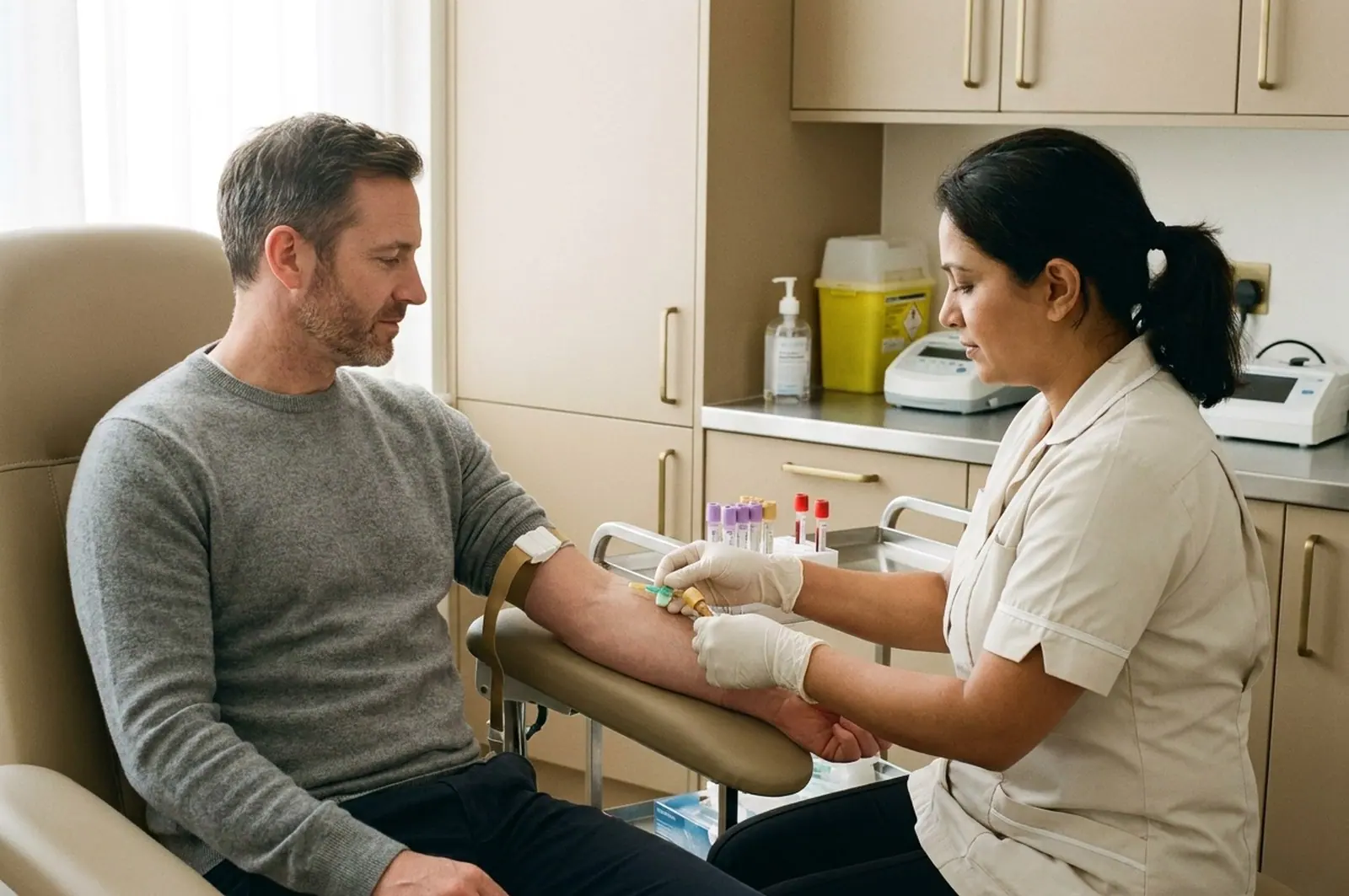
The Basic Male Hormone Screen is a male hormone blood test, and a testosterone test in Liverpool that looks beyond a single number. One venous sample, taken by a clinician at 57 Rodney Street, is tested for 10 markers: total testosterone, SHBG, free testosterone, the free androgen index, LH, FSH, oestradiol, prolactin, DHEA-S and albumin. It gives context on your hormone balance and on whether it is worth taking things further. It does not give a diagnosis, and no GP referral is needed to book.
It is a check on your hormones, not a general health panel. It does not include thyroid, cholesterol, blood count, vitamin D or PSA. The NHS notes that in many men with tiredness, low mood or low sex drive, the symptoms have nothing to do with hormones, so a result inside the reference range is useful information too.
What's tested
10 biomarkers from a single venous sample.
| Marker | What it tells you |
|---|---|
| Albumin | The main protein made by your liver. It reflects nutrition and liver and kidney health. |
| Oestradiol | The main form of oestrogen. It follows your cycle and changes through the menopause. |
| Follicle Stimulating Hormone (FSH) | A pituitary hormone that drives egg development. It rises as the ovaries slow down, including around the menopause. |
| Luteinising Hormone (LH) | A pituitary hormone that triggers ovulation, read alongside FSH and oestradiol. |
| Prolactin | A pituitary hormone that supports milk production. A raised level can affect periods, fertility and libido. |
| Testosterone | The main male sex hormone, also present in smaller amounts in women. It influences energy, mood, libido and muscle. |
| Sex Hormone Binding Globulin (SHBG) | A protein that binds sex hormones, which affects how much testosterone and oestrogen is available. |
| Free Testosterone | The part of your testosterone that is not bound to proteins and is available to your tissues. |
| Free Androgen Index | Testosterone divided by SHBG, an estimate of how much active testosterone you have. It is often used when assessing PCOS. |
| Dehydroepiandrosterone Sulphate (DHEAs) | A hormone made by the adrenal glands that your body uses as a building block for sex hormones. |
Understand what's measured
Plain-English guides to the markers in this panel: what each one checks, and what high and low results can mean.
See all blood test guidesRead more
How this test compares with Thriva, Randox Health and Numan
Who this blood test may suit
You have low energy or a lower sex drive and want to rule hormones in or out
The NHS lists a lack of enthusiasm or energy, loss of sex drive and increased tiredness among symptoms men report in their late 40s to early 50s, and says finding the underlying cause matters. A hormone check is one way to look. Sleep, stress and mood are others.
You have noticed changes in mood, muscle or concentration
The NHS lists mood swings, loss of muscle mass, a reduced ability to exercise and poor concentration among the symptoms it describes. Testosterone is only one possible explanation, and a result gives your clinician something concrete to read alongside your history.
Your training or performance has changed
If recovery, drive or gym performance has shifted and you would like to see where your hormones sit, this panel gives a reference point. It is a snapshot, so many people repeat it later to see which way things are heading.
You are obese or have type 2 diabetes and have symptoms
The NHS says late-onset hypogonadism, where the testes produce few or no hormones, can occasionally develop later in life, particularly in men who are obese or have type 2 diabetes. If that describes you and you have symptoms, a hormone check is reasonable. Your GP is the right person to take any result forward.
You want the reason behind a testosterone number
A total testosterone figure alone gives limited information. This panel adds SHBG, the free androgen index and free testosterone, plus LH, FSH, oestradiol, prolactin and DHEA-S, so that your clinician can read the markers as a group.
What happens at your appointment
- 1
Arrive at 57 Rodney Street for your appointment. No GP referral needed.
- 2
Your clinician confirms the right test for you and answers any questions.
- 3
A quick venous blood draw, taken by a clinician.
- 4
Your results are sent to you securely, with clear guidance on any recommended next steps.
How to prepare for your test
- You do not need a GP referral. You can book this test directly online.
- Whether you need to fast depends on the panel. We confirm exactly what to do when your booking is confirmed, and you can call the clinic if you are unsure.
- Tell your clinician about any medicines and supplements, and about anything you take for training or performance. Some can affect hormone results, and your clinician will want to know.
- Hormone panels can have timing instructions, such as the time of day or whether to eat beforehand. We confirm exactly what to do when your booking is confirmed, so you do not need to work it out in advance.
What your results can and cannot tell you
What they can show
- Where your total testosterone sits against the laboratory's reference range, with free testosterone and the free androgen index calculated alongside it.
- Your SHBG, the protein that binds sex hormones, which affects how much testosterone is available to your body.
- Your LH and FSH, which are made by the pituitary gland and read alongside testosterone and oestradiol.
- Your oestradiol, prolactin and DHEA-S, so that the wider hormone balance is visible, not only testosterone.
- A baseline you can repeat later, so that any change is compared like for like, with the same sample type and laboratory.
What they cannot show
- A diagnosis. The NHS says a diagnosis of late-onset hypogonadism can usually be made from your symptoms together with blood tests that measure testosterone, and that your GP can arrange this. A private panel is information to bring to that conversation.
- That your symptoms are caused by your hormones. The NHS says testosterone falls steadily with age, at about 1% a year from around 30 to 40, which is unlikely to cause problems in itself, and that in many cases the symptoms have nothing to do with hormones. Stress, depression, anxiety, lack of sleep, too much alcohol and smoking are among the other causes it lists.
- Anything outside the 10 markers. Thyroid, cholesterol, blood count, vitamin D, iron and PSA are not part of this panel.
- Anything about fertility. This panel is not a semen analysis and does not assess sperm.
When you get your results, and what happens next
Most results are back within 1–3 working days depending on the panel. They are checked by a clinician and sent to you securely, with clear guidance on what to do next, including onward referral where appropriate. If you would like to talk them through, you can add a 30-minute clinician review for £30.
Your clinician checks your results and sends them to you securely. If a marker falls outside the reference range, they will say so plainly, explain what it may mean next to your symptoms, and suggest a sensible next step. That could be a repeat test, a look at sleep, stress and lifestyle, or a conversation with your GP.
The NHS says your GP may ask about your work and personal life, and may arrange a blood test, and that if results suggest a testosterone deficiency you may be referred to an endocrinologist, a specialist in hormone problems. A 30-minute clinician review of your results can be added for £30, and many people repeat the panel after several months to compare like for like.
Price and booking
The Basic Male Hormone Screen is £100, paid securely online when you book. Appointments are at 57 Rodney Street, Liverpool, Monday to Friday. You can book online, see all test prices, or read how a visit works.
Frequently asked questions
This page is for general information. Blood tests are carried out following a short clinical check to confirm the panel is appropriate for you. Your results are sent to you securely, with clear guidance on any recommended next steps.